
Hayabusa2 achieves new results during asteroid 98943 Torifune flyby.
The Japan Aerospace Exploration Agency (JAXA) spacecraft Hayabusa2 recently conducted a flyby of the asteroid 98943 Torifune. This flyby marks another impo
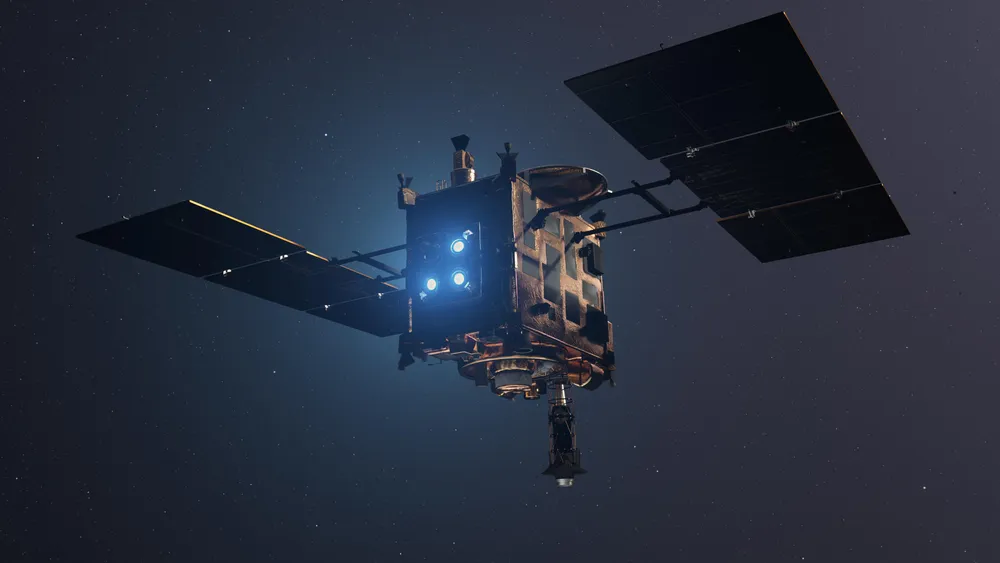
The Japan Aerospace Exploration Agency (JAXA) spacecraft Hayabusa2 recently conducted a flyby of the asteroid 98943 Torifune. This flyby marks another important mission for Hayabusa2 following its 2018 rendezvous with the near-Earth asteroid 162173 Ryugu.
Hayabusa2 is an asteroid sample-return mission that was launched on December 3, 2014. Its predecessor, Hayabusa, successfully returned the first-ever asteroid samples to Earth in June 2010. Hayabusa2 rendezvoused with the asteroid 162173 Ryugu on June 27, 2018, conducting a year and a half of investigation and sampling operations. In November 2019, it departed from the asteroid and successfully delivered the samples back to Earth on December 5, 2020. Its mission has been extended to at least 2031. During this extended period, it will fly by multiple asteroids, including the recent 98943 Torifune, and is scheduled to rendezvous with the rapidly rotating asteroid 1998 KY26 in July 2031.
Hayabusa2 is equipped with multiple scientific payloads, including remote sensing and sampling equipment, as well as four small rovers responsible for investigating the asteroid's surface and analyzing the environmental and geological context of the samples. These instruments enable scientists to gain a deeper understanding of the composition, structure, and evolutionary processes of asteroids. The Hayabusa2 mission not only helps expand humanity's understanding of asteroids, but also provides invaluable data and experience for future space exploration and development.
The Hayabusa2 flyby of asteroid 98943 Torifune is part of its extended mission, and this flyby will provide further data and imagery regarding the asteroid. The name Torifune means "bird ship" in Japanese, and the target is a relatively small near-Earth asteroid. Through this flyby, scientists hope to better understand the asteroid's shape, size, composition, and orbital characteristics.
The Hayabusa2 mission also reflects Japan's continuous progress and investment in the field of space exploration. JAXA has long been committed to developing and executing a wide range of space missions, including planetary exploration, astronomical observation, and space technology development. The success of Hayabusa2 is not only a major achievement for Japanese space technology, but also a model of international space cooperation and exchange.
For Taiwan, the mission and achievements of Hayabusa2 hold significant reference value for understanding asteroids and space exploration. Although Taiwan has not yet directly participated in this type of space mission, by following and learning from international space exploration achievements and experiences, Taiwan can continuously progress and develop in the fields of space technology and scientific research. At the same time, the Hayabusa2 mission also reminds us that space exploration and development are global collaborations and challenges. Countries and regions should work together to promote the advancement and application of space technology, contributing to humanity's future and sustainable development.
Produced by our editorial team, with AI assistance in editing.