
Boone Pickens Stadium
United States · Americas
About
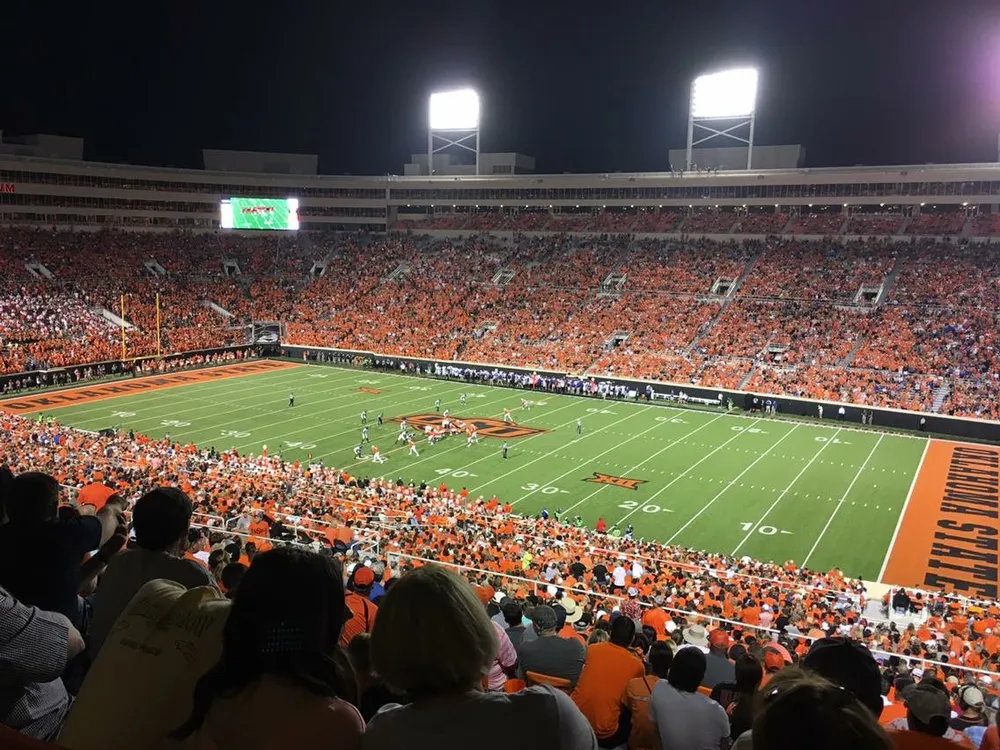
Boone Pickens Stadium (previously known as Lewis Field) is a college football stadium in the south central United States, located on the campus of Oklahoma State University in Stillwater, Oklahoma. It has been home to OSU Cowboys football in rudimentary form since 1919, and as a complete stadium since 1920. With an unorthodox east–west alignment since 1920, the field is the oldest in the Big 12 Conference. With the resurgence of Cowboy football, sparked by consecutive victories over the rival Oklahoma Sooners in the annual Bedlam Series in 2001 and 2002, followed by a win in the Houston Bowl, interest grew for a major overhaul of Lewis Field. An ambitious fund-raising project for the renovation dubbed "The Next Level" became the flagship effort of the Oklahoma State athletic department. The stadium has a seating capacity of 53,885.
Oklahoma State, then known as Oklahoma A&M, first began playing at what would become the original Lewis Field in 1901. Located just north of Morrill Hall and originally known simply as "Athletic Field," it was renamed Lewis Field in 1914 after Lowery Laymon Lewis, a former dean of veterinary medicine and science and literature and one of the most popular figures in the school's history. In addition to his duties as dean and instructor at OAMC, Lewis served as the school's acting president in 1914. Under his brief administration, OAMC established the first school of commerce and marketing in the nation and developed experimental stations around the state. In addition to naming the field after him, the students also dedicated the 1914 yearbook, its first, to Lewis. Lewis Field was relocated to its current site at Boone Pickens Stadium for the 1919 season, following a traditional north–south orientation. In 1920, the school constructed a wooden 8,000-seat grandstand, which approximately corresponds to the lower level of the current facility's north grandstand. The field's orientation was adjusted to an east–west direction to mitigate the impact of strong prevailing winds. It stands as one of only a few major stadiums in the United States with goals positioned at both the east and west ends. Notably, it is the lone stadium with this orientation within the Big 12. As a result, the sun provides a strategic advantage to the team defending the west end zone during sunny afternoon games, while the team defending the east goal must contend with direct and intense sunlight glare. The university planned to build a horseshoe-shaped stadium, similar to Ohio State University's Ohio Stadium, in the 1920s to be called War Memorial Stadium. These plans were scrapped before any construction of the proposed stadium started, and the first addition to Lewis Field came in 1924 with the first steel and concrete portion of the current stadium built on the south side. During the 1929–1930 seasons, 8,000 permanent seats were built on the north side for an overall capacity of 13,000. In 1947 the south stands were increased from 20 to 53 rows and capacity climbed to nearly 30,000. For the first time, a permanent press box was then added. Prior to the 1950 season, 10,600 seats were added to the north stands, increasing capacity to 39,000 (including temporary endzone bleachers). After the 1971 season the cinder track was removed, lowering the field 12 feet and making the space between the field and the stadium retaining walls among the smallest in college athletics. Twenty rows of permanent seats were also added to both sides of the stadium. This expansion, including a complete conversion to an artificial turf playing surface, cost $2.5 million and was financed through private donations. Press box construction was completed in 1980 for $1.8 million. The press box has seating for more than 200 members of the print media, with separate levels for radio/television broadcasters, photographers and VIP seating on the first level capable of handling 300. A lighting system for night games was installed in time for the 1985 season and cost approximately $750,000. The all-time attendance record for Lewis Field is 51,458 for the Bedlam Series game in 1979. On August 7, 1976, the field hosted a National Football League (NFL) exhibition game between the Cleveland Browns and the Atlanta Falcons. The field also hosted the Oklahoma Outlaws and the Houston Gamblers of the United States Football League (USFL) in 1984. Due to a conflict at Tulsa's Skelly Stadium, the Outlaws were forced to play their last Exhibition game in Stillwater, losing to the visiting Gamblers by a score of 34–7. Only 6,120 attended the cold February 19 game.
Adapted from Wikipedia (CC BY-SA). Photography via Wikimedia Commons.