
China Millennium Monument
See all in People's Republic of China →
People's Republic of China · Asia
About
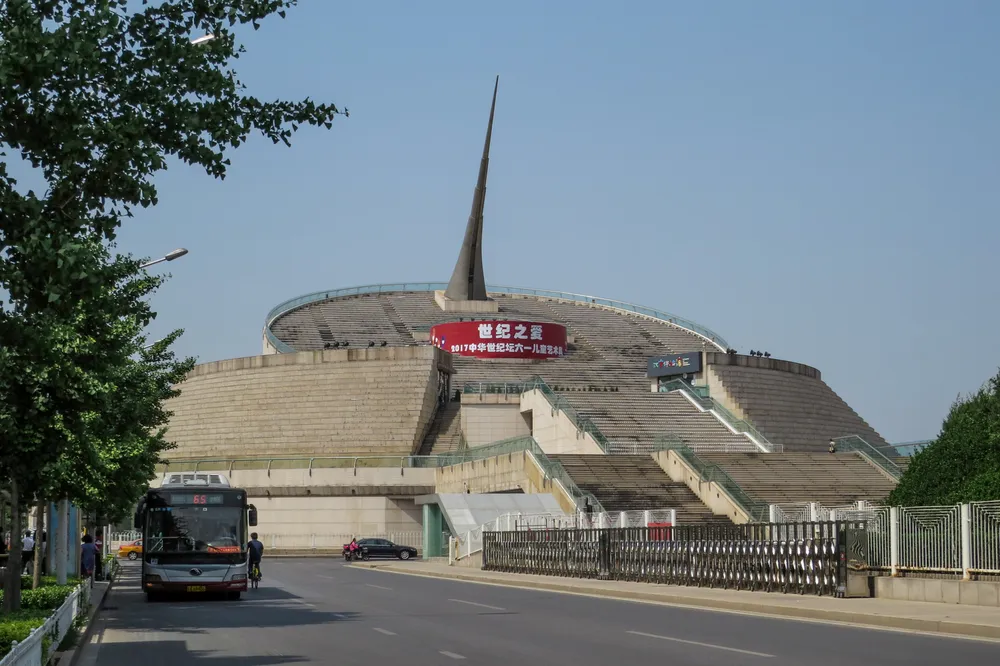
The China Millennium Monument (simplified Chinese: ; traditional Chinese: ; pinyin: Zhōnghuá shìjì tán) is a monumental complex centered around a structure that evokes both a monumental Chinese altar and a sundial. Associated with Jiang Zemin, it was championed from 1994 by CCP official Zhu Xiangyuan. It was completed in 1999 ahead of the Millennium celebrations, for which it was the principal Chinese venue. Since 2006, it has housed the Beijing World Art Museum.
The monument is branded as a monumental altar (simplified Chinese: ; traditional Chinese: ; pinyin: tán), echoing the nine altars that have punctuated the symbolic landscape of Beijing since at least the Ming dynasty. Its architecture also echoes elevated altars where Chinese emperors practiced official rites, such as the Circular Mound Altar at the Temple of Heaven, the Altar and the Home of Shangdi, The Supreme Deity of Chinese Mythology and Theology, and the Altar of Land and Grain near the Forbidden City, and traditional Chinese sundials as also found in the Forbidden City. More generally, the monument is imbued with references to ancient Chinese philosophy, Chinese geomancy, Chinese numerology and Bagua, as well as themes more specifically connected to 20th-century Chinese Communist Party discourse such as the harmony of China's 56 ethnic groups. Like other initiatives such as the creation of Confucius Institutes from 2004, it has been associated with CCP efforts to re-embrace pre-Communist Chinese legacies after the less history-obsessed approach of Deng Xiaoping. The monument's name in Chinese also includes an expression (simplified Chinese: ; traditional Chinese: ; pinyin: shìjì) that depending on context may refer to a century or a less precisely defined epoch or era, and is rendered as "millennium" in the monument's official name in English. The CCP discourse about the monument has emphasized the reference to five thousand years of Chinese nationhood, rather than the new millennium associated with the year 2000 of the Gregorian calendar. It was completed just in time to be the centerpiece of the Millennium celebrations in China, at a cost of 200 million Chinese yuan, but its official inauguration was delayed until Chinese New Year on 5 February 2000. Altogether, the monument's Chinese name can be read literally either as "altar within China dedicated to the new century" or as "altar dedicated to a new Chinese century", thus preserving some ambiguity as to the intensity of its nationalistic intent. Around the time of inauguration, the monument's was strongly associated with the leadership role of Jiang Zemin. A 2000 CCP celebratory poster by propaganda artist Liu Xiqi features Jiang together with his predecessors Mao Zedong and Deng Xiaoping, each flanked with representative architectural icons: Tiananmen Gate for Mao, the Hong Kong skyline for Deng (as architect of the handover of Hong Kong), and for Jiang, the China Millennium Monument on one side and the Pudong District of Shanghai on the other. The monument was the main venue for the July 2001 celebration of Beijing's selection to host the 2008 Summer Olympics. There has been no comparably salient use of the monument since Jiang Zemin's official retirement.
The monument faces south in accordance with Feng Shui principles, and is accessed through a monumental stairway. Its central structure, branded the Century Altar, features 20,000 m2 of exhibition space, much of it underground. The Century Altar is structurally divided between a truncated conic base representing earth (Chinese: ; pinyin: Kūn) and a sundial-shaped rotunda representing heaven (Chinese: ; pinyin: Qián). The latter can rotate around a vertical axis and supports an inclined metal spire branded the "Time and Space Probing Pin" above a central circular platform. The base's diameter is 85 meters, and the rotating sundial's is 47 meters.
Adapted from Wikipedia (CC BY-SA). Photography via Wikimedia Commons.