
Bibracte
France · Europe
About
Bibracte, a Gallic oppidum (fortified settlement), was the capital of the Aedui and one of the most important stone hillforts in Gaul. It was located near modern Autun in Burgundy, France. The material culture of the Aedui corresponded to the Late Iron Age La Tène culture. In 58 BC, at the Battle of Bibracte, Julius Caesar's armies defeated the Helvetii 26 km (16 mi) south of the fort. In 52 BC, Vercingetorix was proclaimed head of the Gaulish coalition at Bibracte. A few decades after the Roman conquest of Gaul, Bibracte was abandoned in favour of Autun, another 25 km (16 mi) away. Once abandoned, Bibracte remained undisturbed and unexamined until discovered by modern archaeology. Jacques-Gabriel Bulliot initiated the first excavations at the site between 1867 and 1895. His nephew Joseph Déchelette, author of a famous Manuel d'Archéologie, continued the excavations between 1897 and 1907. The modern site, known as Mont Beuvray, is generally identified as ancient Bibracte. The site straddles the borders of the French départements of Nièvre and Saône-et-Loire in Burgundy. The site is an archaeological park at the centre of a protected forest. It is the focus of cooperative European archaeological efforts, a training ground for young archaeologists, and a centre for interpreting Gaulish culture for a popular audience. Important international excavations have been undertaken at Mont Beuvray by teams from the universities of Brno, Sheffield, Kiel, Budapest, Vienna and Leipzig.
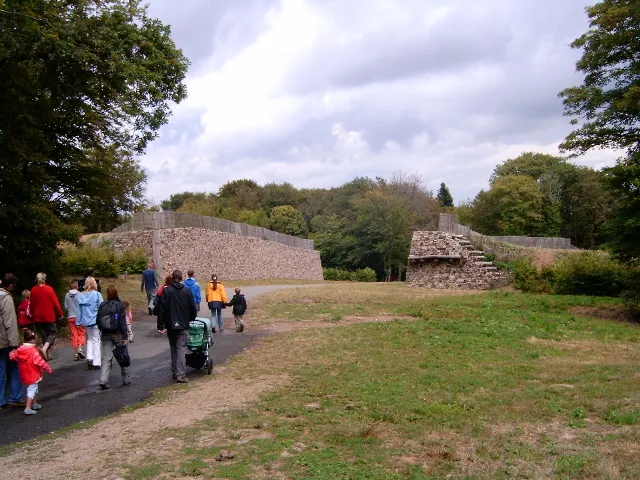
Before the Roman conquest in 52 BC the great Celtic city of Bibracte had more than thirty thousand inhabitants, protected by a huge stone wall of the Murus Gallicus type which enclosed an area of 135 hectares. On 12 December 2007 the site of Bibracte received the "Great Site of France" designation.
The origin of the word Bibracte is still poorly understood. The term may have come from the Celtic *bibro- / *bebro- (beaver) followed by the collective suffix -akti (cf. Irish, Gallic aktā) or from the Latin biffractrus (twice fortified). The latter version, however, is thought questionable from a strategic view, since it is very difficult to protect a battlement over a long distance, a problem which a double battlement would only have exacerbated. Moreover, the stone facing of the outer surrounding wall was reused for the construction of the second wall, meaning it is unlikely that Bibracte was surrounded by two walls at the same time. Three inscriptions dedicated to the goddess Bibracte which were found at Autun in the 17th century provide another explanation for the name, but two of the inscriptions carved into the stone have disappeared and the authenticity of the third, engraved on a brass medallion, has been the object of debate. Some scholars of the era have cited other evidence to justify placing the Aeduian oppidum on the site of Autun (the former Augustodunum), which was effectively the capital of the Aedui in the first century.
Bibracte is mentioned only twice in Roman sources. The first mention is found in Julius Caesar's Commentaries on the Gallic War in the year 58 BC. It was mentioned again in 52 BCE, when he was questioning the intentions of his Aedui allies, who had joined the revolt and crowned Vercingetorix king of the Gauls at Bibracte. Inscriptions from the era announced that the capital of the Aedui received the name Augustodunum (the citadel of Augustus) during the reign of Augustus, which gave rise to the current Autun.
Starting in the 16th century, a passion for local history arose among scholars, aristocrats, and clergy, which led to the question of the location of Bibracte. One theory placed Bibracte at Autun: the Gallic city at the site of the Gallo-Roman city. Another placed it at Beaune and was defended by the scholar Hugues de Salins. A third located the city on the slopes of Beuvrect or Bevrect, today known as Mont Beuvray. This last theory was based on three major arguments. First, there is a connection between the names Bibracte and Beuvrect. Second, medieval chronicles situated the city at Beuvrect. This was reinforced by the existence of an annual fair on the first Wednesday, Thursday, and Friday of May, the age of which is attested to in texts from the 13th century. Finally, the discovery of pottery, coins, and the observations of the priest of Saint-Léger-sous-Beuvray in 1725 supported it. Generally, the Autun hypothesis received the greatest approval at first. Moreover, Autun was renamed Bibracte after the French Revolution and remained so for some time. Only the research of Jacques Gabriel Bulliot in the 19th century shifted scholarly opinion in favor of Mont Beuvray. In 1851, Bulliot communicated with the Congress of the French Society of Archeology about an ancient chapel (the Saint Martin chapel on Mont Beuvray) established to Christianize the Aedui. He also returned to Mont Beuvray to take more notes. He discovered what he thought was the embankment of a Roman camp (actually a nemeton) at the summit of Mont Beuvray next to the chapel. He documented it and considered placing Bibracte at Mont Beuvray instead of Autun, contrary to the unanimous opinion of the Aedui Society. The publication of his Essay on the Roman System of Defense in the Aedui country between the Saône and the Loire, in which he revealed his convictions, was not taken seriously by the members of the Society of Archeology.
Adapted from Wikipedia (CC BY-SA). Photography via Wikimedia Commons.