
Ambarawa Railway Museum
Indonesia · Asia
About
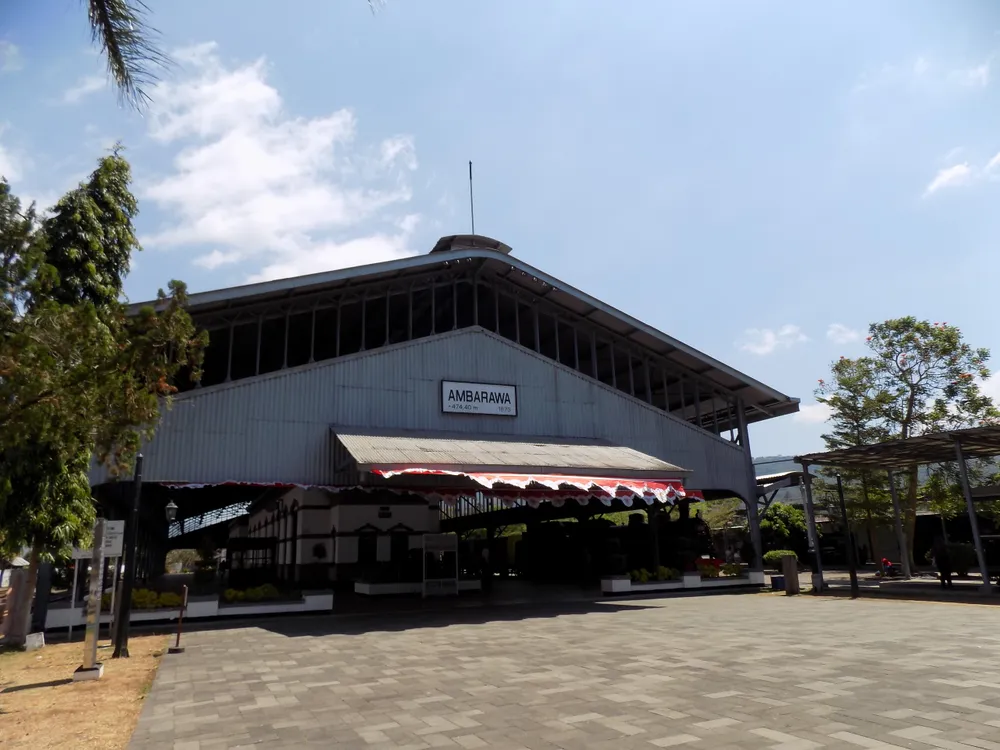
The Ambarawa Railway Museum (Indonesian: Museum Kereta Api Ambarawa, officially named Indonesian Railway Museum by the Indonesian Railway Company) is a museum located in Ambarawa in Central Java, Indonesia. The museum preserves around 21 steam locomotives and focuses on tourism train tours hauled by 3 operational steam engines (both are rack locomotives and a 4-4-0 two-cylinder compound steam engine) and a hydraulic diesel engine, using the remains of the closing of the 3 ft 6 in (1,067 mm) railway line.
Ambarawa was a city that was used for military purposes during the Dutch colonial administration and not far from this station, there's Fort Willem I, known as Benteng Pendem by locals. This station was named Willem I because it was built in honor of the services of the King of the Netherlands William I. The colonial government of the Dutch East Indies under the command of Governor-General L. A. J. Baron Sloet van de Beele ordered the construction of a new railway station to facilitate the mobilization of Royal Netherlands East Indies Army (KNIL) troops from and to Semarang. On 21 May 1873, the Ambarawa railway station was built on a 127,500 m² land. It was finished at the same time as the Kedungjati–Bringin–Tuntang–Ambarawa line by Nederlandsch-Indische Spoorweg Maatschappij (NIS). The station building consists of two main buildings for waiting room and the station master room. The Willem I railway station was originally a transshipment point between the 4 ft 8+1⁄2 in (1,435 mm) gauge branch from Kedungjati to the northeast and the 3 ft 6 in (1,067 mm) gauge line onward towards Yogyakarta via Magelang to the south. It is still possible to see that the two sides of the station were built to accommodate different-sized trains. On 8 April 1976, the Ambarawa railway station was officially converted into the Ambarawa Railway Museum by the governor of Central Java Province at that time Supardjo Rustam. The museum preserves the steam locomotives, which were then coming to the end of their useful lives when the 3 ft 6 in (1,067 mm) gauge railways of the Indonesian State Railway (the Perusahaan Negara Kereta Api, PNKA) was closed. These are parked in the open air next to the original station. In 2010, the building of Ambarawa Railway Museum was made a heritage building.
The construction line between Ambarawa–Samarang (or called Semarang today) was a package with Samarang NIS–Gundih–Solo Balapan–Lempuyangan line. In 1869, after Gundih, the NIS continued the line to Bringin and ended at Ambarawa. Finally, Samarang–Vorstenlanden (now Surakarta and Jogjakarta) and Kedungjati to Ambarawa lines were completed on 21 May 1873. After that, the NIS continued to build rack line to Secang with the line passing through the steep contours and difficult topography in the mountainous area. This line connected the Dutch East Indies military stronghold in Magelang city with Fort Willem I in Ambarawa, and it was finished on 1 February 1905. The 3 ft 6 in (1,067 mm) gauge line towards Djocja Toegoe (Yogyakarta) (runs roughly south-west from Ambarawa) was of particular interest because it contained sections of rack railway between Jambu and Secang which have 6.5% gradient, the only such operation in Java. This line beyond Bedono closed in the early 1970s after it was damaged in an earthquake, but had already lost most of its passenger traffic to buses on the parallel road. The line from Kedungjati (runs east initially from Ambarawa) survived into the middle 1970s but saw very little traffic near the end, not least because it was far quicker to travel more directly by road to Semarang. The presence of the rack line meant that there was probably never much through traffic from Semarang to Yogyakarta.
Adapted from Wikipedia (CC BY-SA). Photography via Wikimedia Commons.