
Brocken
Germany · Europe
About
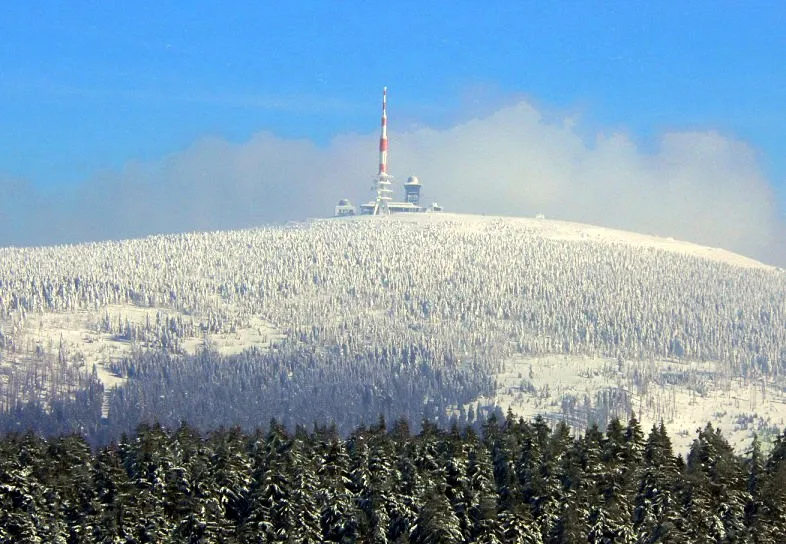
Brocken (German pronunciation: [ˈbʁɔkn̩] ), also sometimes referred to as Blocksberg, is a 1,141 m (3,743 ft) mountain near Schierke in the German state of Saxony-Anhalt, between the rivers Weser and Elbe. The highest peak in the Harz mountain range, and in Northern Germany, it is subalpine, yet has a microclimate resembling that of mountains nearly 1,000 m (3,300 ft) higher. The elevation above its tree line tends to have snowcover from September to May, and mists and fogs shroud it up to 300 days a year. The mean annual temperature is only 2.9 °C (37.2 °F). It is the easternmost mountain in northern Germany; the next prominent elevation directly to its east is in the Ural Mountains in Russia. Brocken has always played a role in legends and has been connected with witches and devils; Johann Wolfgang von Goethe took up the legends in his two-part tragic play Faust. The Brocken spectre is a common phenomenon on this misty mountain, where a climber's shadow cast upon fog creates eerie optical effects. Today Brocken is part of Harz National Park and hosts a historic botanical garden of about 1,600 alpine mountain plants. A narrow-gauge steam railway, the Brocken Railway, takes visitors to the railway station at an elevation of 1,125 m (3,691 ft). FM-radio and television broadcasting make major use of Brocken. The old television tower, the Sender Brocken, is now used as hotel and restaurant. It also has an observation deck, open to tourists.
Brocken rises over Harz National Park in the district of Harz, whose main town of Wernigerode lies about 12 kilometres (7.5 mi) east-northeast of the mountain. The state boundary with Lower Saxony runs past Brocken some 2 km (1.2 mi) to the west. At the south-eastern foot of Brocken lies the spa resort of Schierke. Somewhat to the north below the summit of Brocken is a reservoir, Brockenteich, constructed in 1744. On or near the mountain are the source areas of the rivers Bode, Ecker, Ilse and Oder. The rounded summit of Brocken is treeless, but vegetated with dwarf shrubs.
The highest point on Brocken reaches an elevation of 1,141.1 m above sea level (NN) (3,744 ft). Its subpeaks include the Heinrichshöhe (1,040 m or 3,410 ft), Königsberg (1,034 m or 3,392 ft) and Kleiner Brocken ("Little Brocken") (1,018 m or 3,340 ft). Before 1989, the height of Brocken was recorded in almost all the relevant maps and books as 1,142 m above NN (3,747 ft). A survey of the summit at the beginning of the 1990s based on the current reference system, however, gave the height as 1,141.1 m (3,744 ft). In order to provide a reference point for the old data, granite boulders were set in the mid-1990s on the highest point of Brocken to a height of approximately 1143 m, and a benchmark of "1142 m" was established on them.
From a geological point of view, Brocken and its surrounding terrain (the Brocken massif) consists mainly of granite (called Brocken granite), an igneous rock. The granitic plutons of the Harz – the Brocken, Ramberg and Oker plutons – emerged towards the end of the Harz mountain-building phase of the Upper Carboniferous, about 300 million years ago. First, alkaline magma intruded into the overlying sediments, crystallized out and formed gabbro and diorite massifs, such as the Harzburg gabbro. A little later, silica-rich granitic magma rose, some intruding into voids and gaps in the older rocks, but most being created by the melting of existing sediments. On the boundary between granite and host rock, the so-called contact zone, a great variety of transitions may be seen. For example, the summit of the Achtermannshöhe consists of contact-metamorphosed hornfels of the contact zone that, here, lies over the Brocken granite. The subsequent erosion of the Harz mountains that followed the uplifting of the Harz during the Upper Cretaceous saw the disappearance of the protective hornfels summit, thus exposing the granite that had crystallized underground during the Upper Carboniferous. The alleged hardness of Brocken granite is not the reason for the height of the mountain, but the geological fact that it was well protected by its weather-resistant hornfels crest for a long time before erosion set in. Only in recent geological times, since the Tertiary period, did the typical, rounded, spheroidal weathering of granite outcrops and granite boulders of Brocken take place. Such blockfields are very rare in Central Europe outside the Alps and are subject to conservation measures. They originated mainly under periglacial conditions, i.e. during the course of the ice ages, and their retreat. Today's blockfields of Brocken granite, as well as other rocks in the Harz National Park, particularly in the Oker valley, are therefore at least 10,000 years old. Physical weathering, such as frost shattering, has played a key role in their formation, resulting in giant piles of loosely stacked rocks. In 2006, the granite blockfields of Brocken, together with 76 other interesting geotopes, were designated as a "National Geotope".
Adapted from Wikipedia (CC BY-SA). Photography via Wikimedia Commons.