
Bussell Island
United States · Americas
About
Bussell Island, formerly Lenoir Island, is an island located at the mouth of the Little Tennessee River, at its confluence with the Tennessee River in Loudon County, near the U.S. city of Lenoir City, Tennessee. The island was inhabited by various Native American cultures for thousands of years before the arrival of early European explorers. The Tellico Dam and a recreational area occupy part of the island. Part of the island was added in 1978 to the National Register of Historic Places for its archaeological potential. Native American habitation of Bussell Island dates to the Late Archaic period (c. 3000–1000 BC). The island is believed to have been the location of the capital of Coste—a Mississippian-period chiefdom visited by Spanish explorer Hernando de Soto in 1540—and was later part of the domain of the Overhill Cherokee and the regional homelands of the Cherokee people. In 1887 and 1919, archaeologists conducted extensive excavations at Bussell Island and identified its archaeological importance. The island was drastically modified in the 1970s when the Tennessee Valley Authority (TVA) built Tellico Dam.
Bussell Island is situated where the Little Tennessee River joins the Tennessee River, just over 601 miles (967 km) upstream from the mouth of the latter. The island originally stretched for about a mile up the Little Tennessee, but the construction of Tellico Dam across the island's west river channel in the 1970s created a reservoir that flooded the southern two-thirds of the island. To contain the reservoir, an earthen levee was built along the island's new south shore and across the island's east river channel, connecting the island to the mainland. TVA's construction of a canal connecting the Tellico and Fort Loudoun reservoirs severed this section of the mainland, thus creating a new island that stretches for about a mile east-to-west, and touches three TVA lakes: Fort Loudoun, Watts Bar, and Tellico. Lenoir City is located along the Tennessee River opposite Bussell Island. U.S. Route 321 (Lamar Alexander Parkway) crosses the island's new eastern half, and State Route 444 (Tellico Parkway) traverses the center of the island, with the two roads intersecting on the island's eastern tip. US-321 crosses via the J. Carmichael Bridge, which spans both Fort Loudoun Dam and the canal. John W. Emmert, who conducted excavations on the island in 1887 for the Smithsonian Institution, stated that the original island covered 200 acres (81 ha), and rose to a maximum of 15 feet (4.6 m) above the river. Emmert described the island's banks as "steep" with "heavy timber and much cane growing along them." Emmert also noted that the island was occasionally submerged when the Little Tennessee flooded, and noted that his excavation work was interrupted by one such flood which submerged the island to upwards of 12 feet (3.7 m).
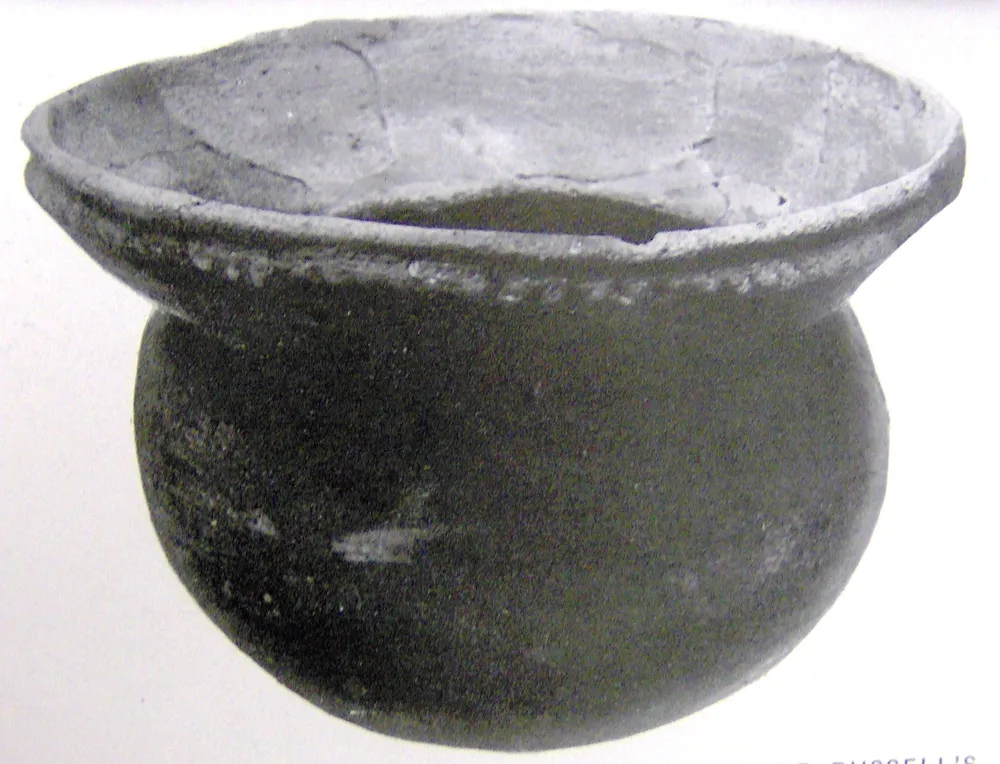
The earliest known inhabitants of Bussell Island lived during the Late Archaic period (c. 3000–1000 BC), and occupied the island sporadically throughout the Woodland period (1000 BC – 1000 AD). Archaeologist Mark R. Harrington, who conducted extensive excavations in the area in 1919 for the Heye Foundation, called these early inhabitants "Round Grave" people, due to their practice of burying their dead in small, round graves. The Round Grave people used tools made of animal bone and stone, and used both steatite vessels and simple pottery. The successors to the Round Grave people at Bussell Island were a people Harrington simply called the "Second Culture." This culture was part of what is now known as the Mississippian culture, which flourished in the upper Tennessee Valley between 900 and 1600 AD. The Mississippian people of the upper Tennessee Valley are known for building large, earthwork platform mounds and conical burial mounds, including several found on Bussell Island and the surrounding mainland. Bussell Island's Mississippian inhabitants used triangular flint arrowheads, celt axes, and wore ornaments made from copper and seashells (the latter suggesting trade with coastal regions).
Adapted from Wikipedia (CC BY-SA). Photography via Wikimedia Commons.