
Bardsey Island
United Kingdom · Europe
About
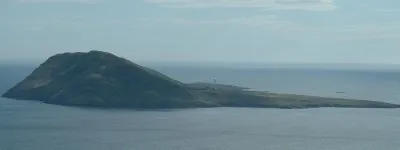
Bardsey Island (Welsh: Ynys Enlli), known as the legendary "Island of 20,000 Saints", is located 1.9 miles (3.1 km) off the Llŷn Peninsula in the Welsh county of Gwynedd. The Welsh name means "The Island in the Currents", while its English name refers to the "Island of the Bards", or possibly the Viking chieftain, "Barda". At 179 hectares (440 acres; 0.69 sq mi) in area it is the fourth largest offshore island in Wales. As of 2025 it had a year-round population of three. The north east rises steeply from the sea to a height of 548 feet (167 m) at Mynydd Enlli, which is a Marilyn, while the western plain is low and relatively flat cultivated farmland. To the south the island narrows to an isthmus, connecting a peninsula on which the lighthouse stands. Since 1974 it has been included in the community of Aberdaron. The island has been an important religious site since the 6th century, when it is said that the Welsh king Einion Frenin and Saint Cadfan founded a monastery there. In medieval times it was a major centre of pilgrimage and, by 1212, belonged to the Augustinian Canons Regular. The monastery was dissolved and its buildings demolished by Henry VIII in 1537, but the island remains an attraction for pilgrims, marking the end point of the North Wales Pilgrims Way. Bardsey Island is famous for its wildlife and rugged scenery. A bird observatory was established in 1953. It is a nesting place for Manx shearwaters and choughs, with rare plants, and habitats undisturbed by modern farming practices. The waters around the island attract dolphins and porpoises and grey seals. In 2023, the island became the first site in Europe to be awarded International Dark Sky Sanctuary certification.
Like the western and northern parts of nearby Llŷn, the island is formed from rocks of the late Precambrian Gwna Group, itself a part of the Monian Supergroup. The rocks are a mélange, often referred to as the Gwna Mélange, which contain an extraordinary mix of clasts of all sizes up to 100 metres (330 feet) across and of very varied types, including both sedimentary and igneous origin. Blocks of sheared granite within this mélange are visible in the northwestern coastal cliffs of the island. Elsewhere clasts of quartzite, limestone, sandstone, mudstone, jasper and basalt can be found. The deposit is interpreted as an olistostrome, a giant underwater landslide possibly triggered by an earthquake some time after 614 million years ago. A dolerite dyke of Ordovician age intrudes the melange at Trwyn y Gorlech in the north whilst an olivine dolerite dyke of Tertiary age is seen at Cafn Enlli in the southeast. Further dykes occur in the cliffs at Ogof y Gaseg and at Ogof Hir. A thin spread of glacial till stretches across the centre of the island, a relict of the late Devensian Irish Sea Icesheet. There is a small patch of blown sand at Porth Solfach on the west coast and a landslip at Briw Cerrig at the foot of the cliffs on the east coast.
The island was inhabited in Neolithic times, and traces of hut circles remain. During the 5th century, the island became a refuge for persecuted Christians, and a small monastery existed. Around 516, Saint Einion, king of Llyn, invited the Breton Saint Cadfan to move to the island from his first residence in Tywyn. Under Cadfan's guidance, St Mary's Abbey was built. For centuries, the island was important as "the holy place of burial for all the bravest and best in the land". Bards called it "a direct path to heaven" and "the gates of Paradise", and in medieval times three pilgrimages to Bardsey were considered to be of equivalent benefit to the soul as one to Rome. In 1188, the abbey was still a local institution but, by 1212, it belonged to the Canons Regular. Many people still walk the journey to Aberdaron and Uwchmynydd each year in the footsteps of the saints, although today only ruins of the old abbey's 13th century bell tower remain. A Celtic cross amidst the ruins commemorates the 20,000 saints reputed to be buried on the island. Saint Einion is sometimes claimed to have joined the community on the island, although his relics are claimed by Llanengan on the mainland. Saint Deiniol, the Bishop of Bangor, was buried on the island in 584. Saint Dyfrig was also buried on Bardsey Island, although in 1120 his remains were transferred to Llandaff centuries later.
Adapted from Wikipedia (CC BY-SA). Photography via Wikimedia Commons.