
Anticosti Island
Canada · Americas
About
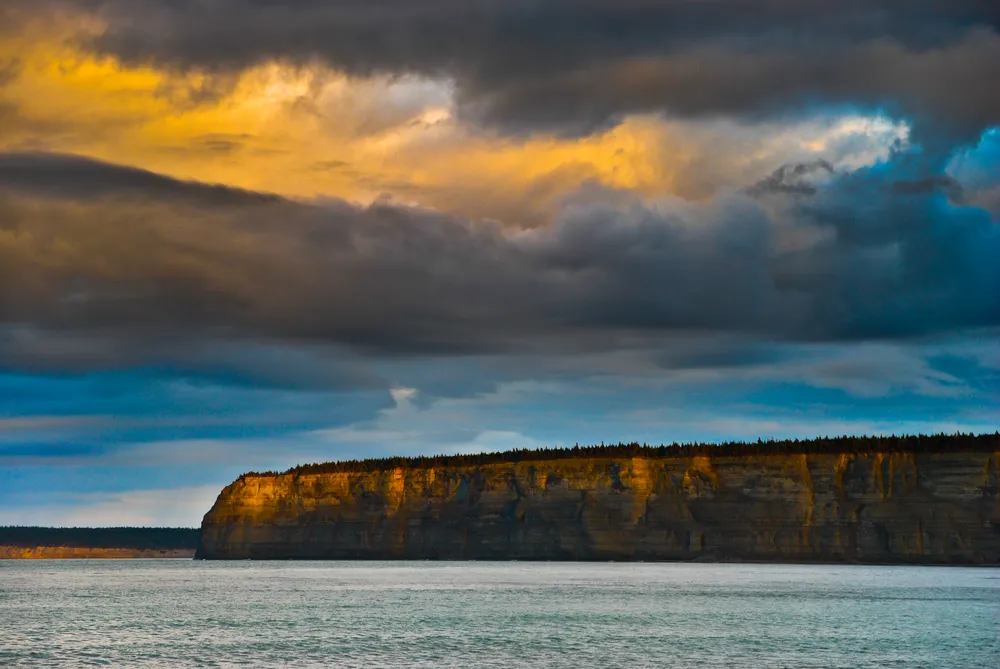
Anticosti Island (French pronunciation: [ɑ̃tikɔsti]) is a large but sparsely populated island belonging to the Canadian province of Quebec. It lies in the Gulf of St. Lawrence, and is separated from mainland Quebec by the Jacques Cartier and Honguedo straits. Administratively, it forms a municipality of the Côte-Nord region. The area of the island is 7,953.55 km2 (3,070.88 sq mi).
The name Anticosti first appeared in the writings of Samuel de Champlain in 1603, as Anticosty. It apparently represents a corruption of the earlier Nadicousti, recorded by André Thevet in 1586 and described by him as the Amerindian name for the island (the European name, bestowed by Jacques Cartier in 1535, being Isle de l'Assumption). Its origin and meaning are unclear, though William Francis Ganong speculatively ascribed it to the St. Lawrence Iroquoian language. The Montagnais name for the island is Notiskuan, meaning "where bears are hunted", while the Micmac name is Natigôsteg, meaning "forward land".
For thousands of years, Anticosti Island was the territory of the Indigenous peoples who lived on the mainland and used it as a hunting ground.
The French explorer Jacques Cartier sailed along its shore in the summer of 1534. From that time on, France had officially incorporated the island into its colonial empire. The island's first European settlers arrived in 1680 when Louis XIV gave Louis Jolliet the Seigneury of the Mingan Archipelago and Anticosti Island as compensation for reconnoitring the Mississippi and Hudson Bay. Louis Jolliet erected a fort on Anticosti and in the spring of 1681 settled there with his wife, four children and six servants. His fort was captured and occupied during the winter of 1690 by some of the Massachusetts troops of William Phips during their retreat after an unsuccessful attempt to capture Quebec City. After Jolliet's death in 1700, the island was divided among his three sons and the Jolliet family retained ownership until 1763 when the island became part of British North America under the terms of the Treaty of Paris that ended the Seven Years' War. That same year, the island was annexed to Newfoundland until 1774 when it was returned to Lower Canada and annexed again to Newfoundland from 1809 to 1825. It became a part of Quebec (as Lower Canada came to be called) at the Canadian Confederation in 1867. During these years the island property changed hands several times, its owners generally using it for the harvesting of timber; otherwise no real development took place. For example, the French Canadian Gabriel-Elzéar Taschereau owned it among other seigneuries and made money from them.
In 1874, it was bought by the Anticosti Island Company and they founded the villages at English Bay and Fox Bay. Most of the inhabitants, however, continued to be the few keepers of the island's many lighthouses. Because of the number of shipwrecks around the island, stores of provisions were also maintained around the island for sailors who might be washed ashore. In 1882, the Parish of Notre-Dame-de-l'Assomption was founded, a term referring to Cartier's name for the island. In 1884, the island became property of the Stockwell brothers who formed a forestry company two years later. But they were unsuccessful and the company lasted only five years. By the 1890s, the fish and wildlife of the island had been almost eradicated through European overhunting.
In 1895, Anticosti was sold for $125,000 to French chocolate maker Henri Menier who also leased the shore fishing rights. Menier named the island's 70-metre-high (230 ft) Vauréal Falls after the town of Vauréal in France where he owned a home. He constructed the entire village of Port-Menier, built a cannery for packing fish and lobsters, and attempted to develop its resources of lumber, peat and minerals. Many of the original houses still stand today. Furthermore, he converted the island into a personal game preserve and introduced nonindigenous animals for this purpose, including a herd of 220 white-tailed deer. The deer thrived and today the population exceeds 160,000 while the island's moose population is about 1,000. It has been reported that black bears, which rely on berries to bulk on for the winter, had lived on the island until the introduction, but have disappeared perhaps because of the deer eating the berry bushes bare.
Adapted from Wikipedia (CC BY-SA). Photography via Wikimedia Commons.