
Bethanga Bridge
Australia · Oceania
About
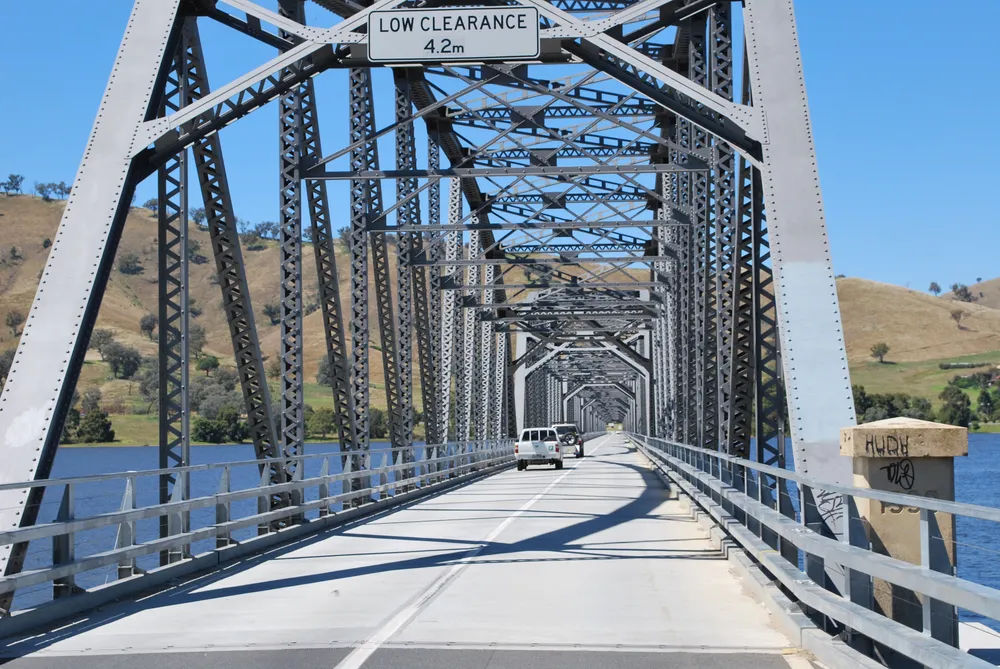
The Bethanga Bridge is a steel truss road bridge that carries the Riverina Highway across Lake Hume, an artificial lake on the Murray River in Australia. The dual heritage-listed bridge crosses the border between the Australian states of New South Wales and Victoria, linking the Victorian towns of Bellbridge and Bethanga with the regional New South Wales city of Albury.
The first crossing of the Murray River by white men occurred in November 1824 when Hamilton Hume and William Hovell led an expedition from Yass in search of an overland route to Westernport Bay. Their crossing point was some distance up river from Albury and an obelisk near the river commemorates this. Hume and Hovell came upon the river on 16 November 1824, naming it the Hume River, and inscribing a tree near the riverbank the next day before moving on to the south. In 1829, the explorer Charles Sturt discovered the Hume River downstream at its junction with the Murrumbidgee River. Not realising it was indeed the Hume, he named it the Murray River. Both names persisted for some time, Hume falling into disuse eventually in favour of Murray. The explorers route was shortly followed by white squatters and their livestock, mainly sheep and cattle. Subsequently, many families took up parcels of grazing land on the rich river flatlands, among the first being William Wyse and Charles Ebden. The drovers track that developed along the line of the advancing squatters, and subsequently by their excess stock returning for sale at Melbourne and Sydney markets, led naturally to the same point Hume and Hovell first sighted the river. Although an easier crossing point could be found 10 miles upstream (where the Hume Dam now stands) the original site by Hume and Hovel's inscribed tree became the popular crossing place for people and stock on their way to new settlements in the south. Crossing the river during the drier summer months could normally be achieved on foot. When the river was high after heavy rains or snow melting in the mountains crossing became difficult until a log punt was built in 1844. Stock, however, had to swim. The first bridge over the Murray was built in 1860 near the present crossing at Albury. People up and down stream had to find their own fords, or trek back to Albury. The arrival of the railway from Melbourne in 1873 boosted the district and captured the Southern Riverina markets for Melbourne. The railway line from Sydney reached Albury in 1881, but the Albury-Wodonga Railway Bridge over the Murray was not opened until 1883. The Bethanga-Talgarno gold and copper field became one of the top copper producers in Victoria although both minerals proved difficult to extract from the intractable ores. The alluvial field was first reported in 1852 and was visited by mining officials in 1854, but the field was not really opened up until the discovery of the New Year's Gift reef on 1 January 1876. This led to a number of highly capitalised mining ventures. Harris and Hollow, a mining partnership from Rutherglen, built a smelting works on the flats of lower Bethanga with a view to smelting copper for the public and opened the first furnace of their Great Eastern Copper Smelting works in January 1878. John Wallace MLC took an interest in the Bethanga mining scene and purchased mining leases and major mines at Bethanga, then built his own smelting works to treat the ore, completing three furnaces by June 1878. The Bethanga Goldfields Ltd company made a takeover in 1895 and both metals were mined and treated. Mining however, continued only sporadically into the 20th century, with further leads opened at Mount Corryong and Mount Talgarno. There was a brief revival in the 1930s and some mines struggled on to at least 1945, but in the latter half of the 20th century mining ceased and the town gradually diminished (Bannear). The concept of damming Australian rivers for irrigation and flood mitigation was first investigated back in the days of the steamers. The Hume Dam was proposed under the River Murray Waters Agreement, which was signed on 9 September 1914, by the Prime Minister, Joseph Cook, and the Premiers of New South Wales, Victoria and South Australia. The first sod was turned by His Excellency, the Right Honourable Sir Ronald Crawford Munro-Ferguson, Governor-General of Australia, on 28 November 1919. H. V. Beresford was construction engineer on the Hume Weir from about 1925, but died while still engaged on the project in 1927. At the height of construction, more than 1100 workers were employed at the site. These workers were housed in two fully serviced towns adjacent to the site, one on either side of the river. Construction of the weir took seventeen years with the reservoir being completed and officially opened by the Right Honourable Lord Gowrie, Governor of NSW, on 21 November 1936 and a plaque on the northern pier of the dam commemorates the occasion. The Bethanga Bridge was evidently constructed in the middle of this period, probably when water backing-up behind the rising dam wall, began to reach the low level bridge at Bethanga. Three engineers of note were involved in formulating the agreement, Ernest de Burgh, the Chief Engineer of the Water Supply Branch of the NSW Public Works Department, J. S. Detheridge the Commissioner, State Rivers and Water Supply of Victoria, and G. Stewart in South Australia. The initial designs for Hume Dam were prepared by de Burgh and Detheridge. NSW was responsible for construction of the concrete dam and the State Rivers and Water Supply Commission of Victoria was responsible for the southern earth embankments. Another Victorian engineer, Ettore Checchi (1853–1946) was closely connected with the Hume Dam project in the 1920s and 30s. However, as his skills were with hydrographic work, it is unclear what contribution he had to the associated structures such as Bethanga Bridge. The State Rivers and Water supply Commission undertook at least some of the Hume Weir works in conjunction with the NSW Public Works Department. The River Murray Commission evidently had an overriding supervision of the works, but engineering and design details were left to the established public works engineers in the two states. The heavy cost of Victoria's irrigation infrastructure lead to a parliamentary inquiry into the commission's finances in 1928, and recommendations against further irrigation investment in an era of low export returns from primary produce. However, the Hume scheme appears to have been immune to any cuts due to the State - Federal agreement and advanced stage of the project. The NSW Department of Public Works carried out modifications between 1950 and 1961 to enlarge the dam to about twice its original size to the present capacity of 3,038 gigalitres (668×10^9 imp gal; 803×10^9 US gal) to accommodate diverted water from the Snowy Mountains Scheme.
Adapted from Wikipedia (CC BY-SA). Photography via Wikimedia Commons.